Just how long does permanent straightening really stay sleek, and what happens when it starts fading, especially in those crucial first 72 hours?
Think about the way an iron presses a stubborn crease into a linen shirt. Permanent straightening works on the same principle, only it’s pressing your hair into a brand new shape from the inside out. With Japanese straightening or rebonding, you can expect months of glassy smoothness because chemicals and heat reset the bonds living inside every strand. The finish you walk away with, how it fades, and whether your hair stays healthy, all of that comes down to your texture, your climate, and the choices you make in the first 72 hours. And honestly, that last part is where most people slip up.
I.Japanese vs. Rebonding: How Each Method Actually Works
So what’s actually different between Japanese straightening and rebonding? It comes down to how each one approaches the chemistry of your hair.
Japanese techniques rely on cysteine solutions, which gently break the bonds in your hair to create a sleek, fluid finish that still moves with you. It feels like your hair, just smoother. Rebonding takes a stronger route, using agents like formaldehyde to fully sever the protein bonds, leaving you with a flat, polished look that holds firm. It’s especially effective on coarse, resistant hair that fights back against gentler methods.
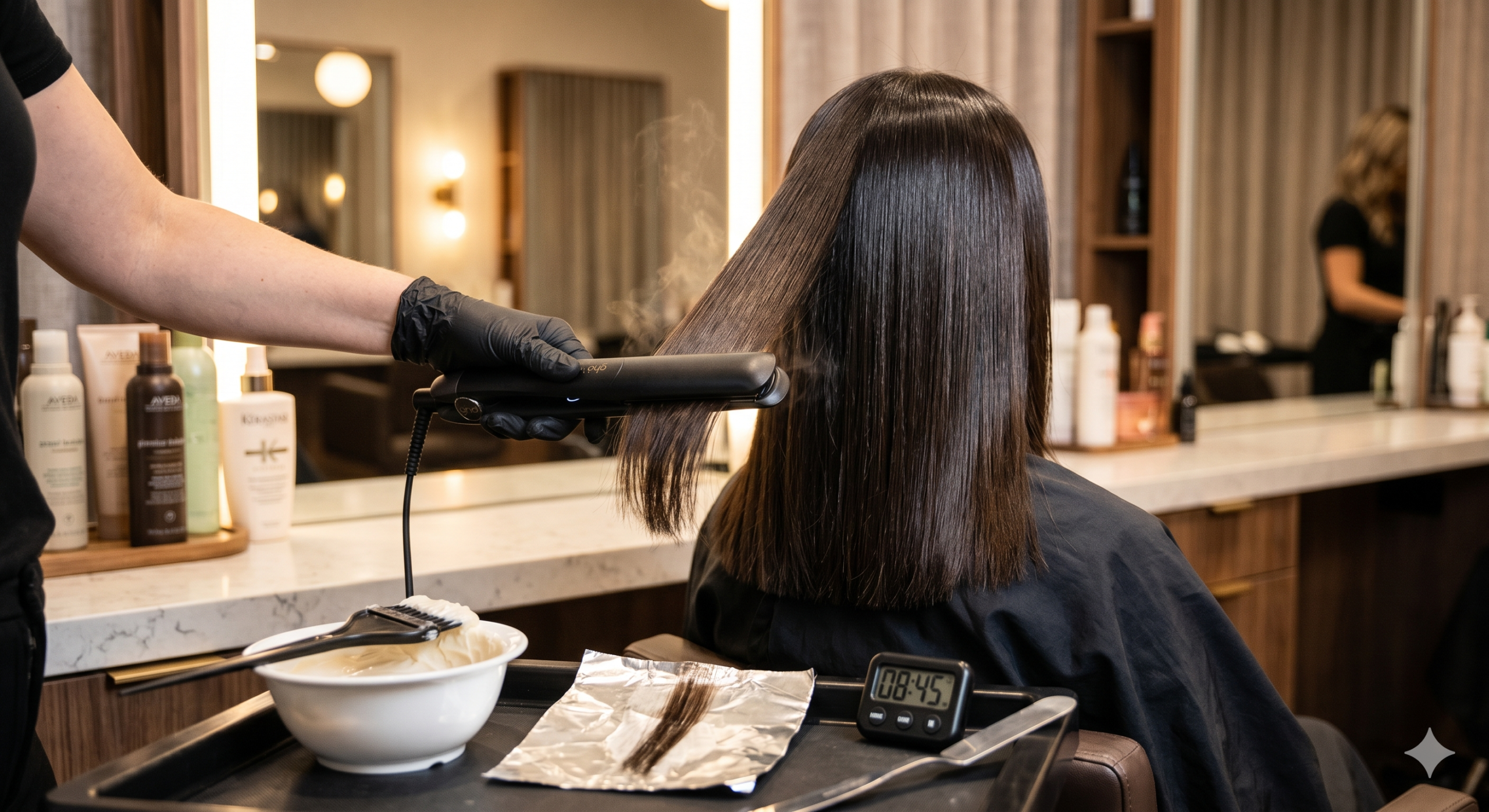
Both approaches use heat to lock things in place, but rebonding asks for higher temperatures and creates a stiffer structure that won’t bend back into curls.
Rebonding works at higher heat to forge a structure so firm it simply won’t curl, locking your style in place for the long haul.
If you want shine and a little flexibility, Japanese methods are usually the way to go. If you’re after that ultra-straight, glass-like finish on resistant hair, rebonding tends to deliver. Knowing how each method works on a chemical level helps you pick the right one for your texture without putting your hair’s health on the line.
One thing worth flagging: both processes involve strong chemical scents that may linger during and after your appointment.
II.How Long Does Each Method Actually Last?
There are really two timelines at play. Permanent methods like Japanese straightening and rebonding stay until you cut or grow them out. Semi-permanent options, like keratin treatments and Brazilian blowouts, fade gradually over three to six months.
Japanese results can hold for up to a year. Rebonding usually carries you through five to seven months before regrowth starts demanding attention. Semi-permanent treatments wash out slowly, and how well they hold depends almost entirely on your aftercare.
The right products make a real difference in how long your style stays sleek. Salon treatments restructure the bonds deep inside your hair, while DIY kits often fall flat much faster.
Maintenance windows are personal. Some people stretch eight months between visits, others book in every few weeks. Pick the method that fits your life, and know roughly how long you’ve got before nature steps back in. Just know that keratin treatment results specifically last 3 to 6 months, depending on your hair type and how you care for it.
III.How Your Hair Texture Shapes the Outcome
How long your results last isn’t just about the method, it’s about the canvas you’re starting with. Porosity sets the absorption rate. High porosity hair drinks in solution fast but doesn’t hold it well, so results can fade in 6 to 10 weeks without proper repair. Medium porosity tends to hold strong for 4 to 6 months. Low porosity hair takes more processing to reach the inner bonds in the first place. To help your results stick, aim for 2 to 3 washes a week, since over-washing speeds up the breakdown.
Curl pattern and bond strength matter too. Type 2 waves shift more easily and can hold for 4 to 5 months. Tighter coils need stronger restructuring and tend to show roots a bit sooner.
Strand thickness and density factor in as well. Fine strands average around 4 months, while coarse fibers can hold for 5 to 6. If your hair has been colored or damaged, its chemical resilience drops, which means results can vary more than expected.
IV.Can Humidity Really Undo Your Treatment?
Even after chemically straightening, humidity can still mess with your hair on the surface. Moisture sneaks into the strand and breaks the weaker hydrogen bonds, which are the ones that haven’t been chemically reset.
What you’ll see is the shaft swelling, the cuticle lifting, and new bonds setting as your hair dries. That can show up as frizz or soft bends, especially at new growth or untreated ends.
Here’s the good news. True permanent methods like Japanese thermal reconditioning and chemical relaxers reset much stronger bonds, so the treated lengths stay sleek even in muggy weather.
Where you’ll feel humidity most is with keratin smoothing. It coats and calms your hair beautifully, but in extreme humidity, a faint wave can creep back in.
Drying your hair completely before styling helps minimize frizz, because any leftover dampness reacts more dramatically once you step out into humid air.
Sweat, UV exposure, chlorine, saltwater, and frequent washing all speed up fading, so gentle habits go a long way in protecting your finish.
V.What Each Method Costs You (in Time and Money)
Time and money commitments shift quite a bit depending on which method you choose.
A salon perm is the quickest and most budget friendly, taking just a few hours and starting around $50.
Keratin smoothing typically runs between $250 and $450, with appointments lasting 1 to 3 hours, sometimes split across multiple visits.
Keratin smoothing usually runs $250 to $450 and takes 1 to 3 hours, sometimes split across a couple of visits.
Japanese thermal straightening asks the most of you. Plan for roughly 5 to 6 hours in the chair and anywhere from $200 to $800 or more.
Hair rebonding sits in the middle, around 2 to 4 hours and $250 to $1,000. At-home kits start near $15, but they need frequent touch ups, and if something goes wrong, fixing it can cost you far more than booking a salon visit would have.
When you’re comparing costs, factor in longevity. Perms last 4 to 6 months, keratin 3 to 5, rebonding 5 to 7, Japanese 6 to 12, and at-home options about 6 weeks. For time efficiency, count touch ups in the math too.
VI.Is Formaldehyde Hiding in “Safe” Treatments?
Price and appointment length matter, but what you’re breathing during a “safe” smoothing service can matter even more.
Some straightening and smoothing formulas still contain formaldehyde or formaldehyde-releasing chemicals that turn into gas when your stylist hits your hair with a flat iron. The risks aren’t theoretical. Irritation can begin around 0.1 ppm, and salon air studies have measured levels that exceed short-term exposure limits.
You might notice burning eyes, headaches, a cough, wheezing, nausea, or rashes, while the person next to you feels nothing at all.
A poorly ventilated salon raises your chances of inhaling formaldehyde gas during the heat step.
You can protect yourself, and your community, by insisting on ingredient transparency. Check labels for formaldehyde, formalin, or methylene glycol, and ask your stylist what they’ll be using before any heat goes near your hair. Not every product contains it, which is exactly why verification matters.
VII.How to Prevent Damage From the Start
Permanent straightening breaks and resets the bonds inside your hair, so damage prevention starts long before the first product touches your strands. It comes down to how well you prepare, who you trust to do the work, and treating aftercare like part of the appointment, not an optional extra.
Show up with healthy hair. Skip washing for 2 to 3 days beforehand, and don’t underestimate the consultation. A scalp check, a full color history, and a strand test will tell your stylist how your hair will respond and how much time it can safely handle.
Arrive with healthy hair, hold off on washing for 2 to 3 days, and insist on a real consultation: scalp check, color history, and a strand test.
For the application itself, professional skill matters. You want even saturation, careful spacing from the scalp, and precise timing. Ask for formaldehyde free, professional grade options, and don’t be shy about requesting bond-building additives or a barrier cream. Proper ventilation is essential if any product might release formaldehyde fumes. Finish with a deep conditioner or neutralizer to reseal the cuticle.
At home, keep things gentle. Use sulfate and salt-free wash care, deep mask once a week, work in a daily leave-in, ease up on hot tools, and book trims every 6 to 8 weeks.
VIII.Why the 72-Hour Rule Is Non-Negotiable
The 72 hours after a permanent straightening service are what’s known as the curing window. During that time, the neutralizer keeps oxidizing and locking your hair’s new disulfide bonds into place.
You’re not just waiting around. You’re protecting the chemical stability of the treatment while the bonds work their way up to full strength, which usually peaks around hour 72.
If you wet your hair too early, whether from washing, swimming, sauna steam, or even a sweaty workout, water swells the cortex and can deactivate the neutralizer, leaving the bonds only half formed.
That’s when frizz comes back fast and the straight finish can fade within just a few washes, sometimes cutting longevity by 30 to 50 percent.
Keep your hair down for those three days. Skip hats and tight ponytails. Avoid friction from cotton pillowcases that can press dents into your hair while it’s still setting.
It’s also smart to wait at least 3 to 4 weeks before any color service so the freshly rebuilt bonds aren’t put under stress while they’re still settling in.
Stick to the 72-hour rule and your sleek results will actually go the distance.
IX.Which Shampoos Protect Your New Bonds?
Once you’ve made it through the curing window, your shampoo becomes the next make-or-break factor for keeping those freshly set bonds smooth and strong.
Reach for sulfate free formulas that cleanse without stripping oils or loosening your treatment. Skip sulfates, sodium chloride, and drying alcohols entirely.
Lean into moisturizing ingredients like panthenol, glycerin, hyaluronic acid, and argan or shea oils, which help prevent the dryness that quickly turns into frizz.
For added structure, rotate in a keratin or amino acid shampoo to reinforce your hair without overdoing the protein.
Pay attention to pH too. A pH-balanced formula (around 4.5 to 5.5) keeps the cuticle sealed and your finish glossy.
Use clarifying shampoos sparingly. They’re great for lifting buildup occasionally, but not as a weekly regular. Frequent washing can also shorten how long your straightening lasts by speeding up the breakdown of the treatment.
X.When to Book Your Next Touch-Up
So when should you book that next root touch-up? A 6 to 8 week rhythm tends to work best. Hair grows about half an inch a month, and touch-ups start making sense once you spot around an inch of new growth.
Because straightening isn’t truly permanent, regrowth will gradually bring your natural texture back at the roots.
If your hair grows quickly, your touch-up window may be tighter. Heat from your scalp can also bring roots in faster. Curly and coily textures often show contrast quickly, so try not to wait until you see a sharp dividing line.
Keep an eye out for these regrowth signs:
- A clear one-inch halo of natural texture along your part
- Frizz or puffiness lifting at the crown
- Two textures fighting your brush and flat iron
- Smooth lengths, but roots that feel bumpy and uneven
Book before that line appears, and you’ll keep your sleek finish on lock.