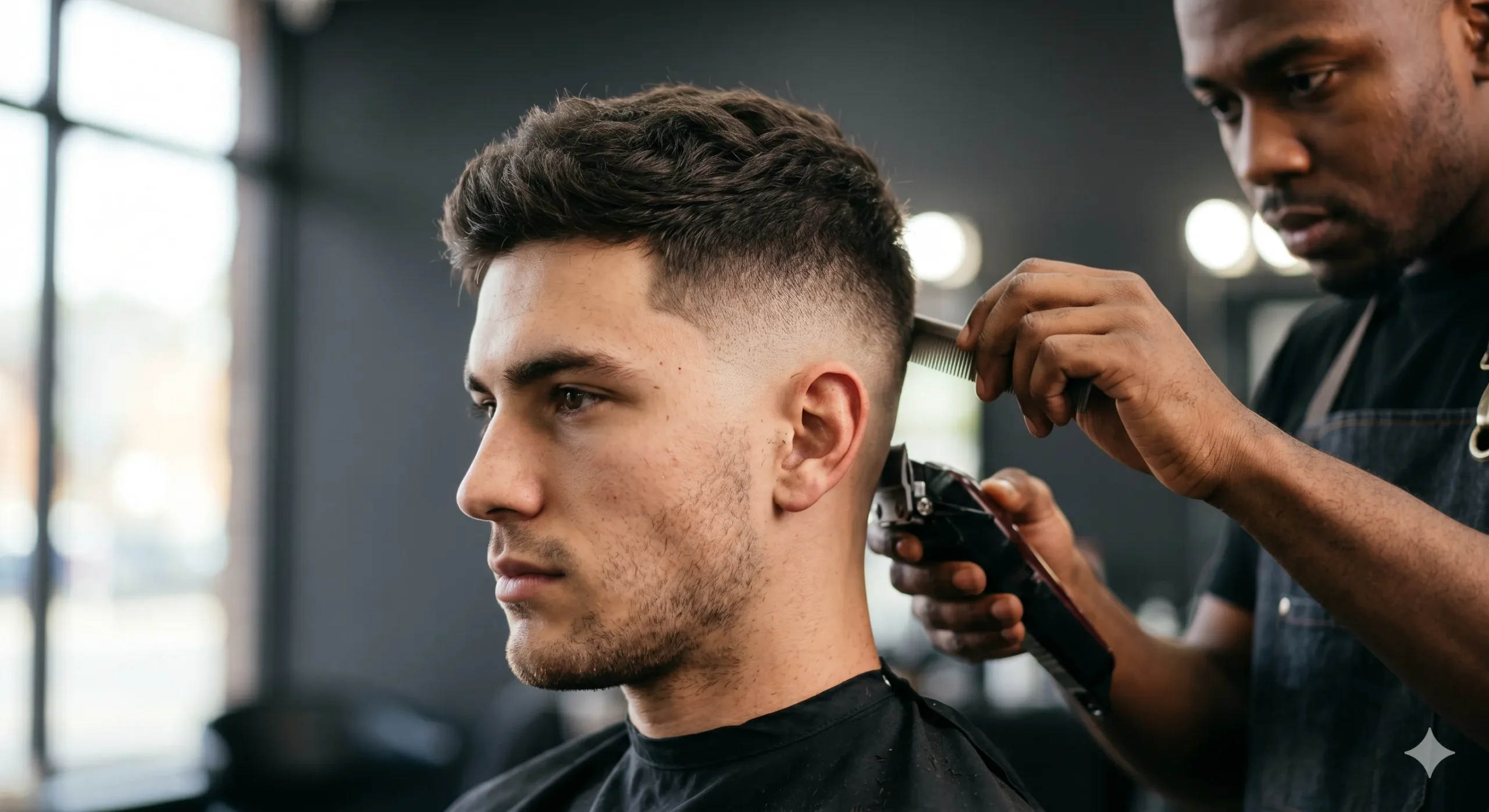
A skin fade looks deceptively simple. But where that fade actually starts on your head changes everything about how your face reads in the mirror. Pick the right height and you’ll look sharper, more balanced, more like yourself. Pick the wrong one and you’ll quietly emphasize the features you were hoping to soften. Here’s how to figure out which one is yours before you sit down at the chair.
The Quick Version
- Round face? Go high. The vertical line slims and lengthens you.
- Diamond face? Stick with mid or low. You want softness around the temples, not exposure.
- Heart-shaped? A low fade with a side-swept top balances a wider forehead beautifully.
- Oval face? Lucky you. Pretty much anything works, so play around.
- Square jaw? Pair a high fade with a textured top to add height and break up the angles.
So What Actually Separates a Low, Mid, and High Fade?
The name “skin fade” just means the hair is taken all the way down to bare skin somewhere on your sides. The low, mid, or high part is about where that fade starts.
A low fade kicks in just above your ear. It’s understated, professional, and plays well with almost any workplace. Most of your side hair stays put, so the look is subtle.
A mid fade begins roughly halfway up the side of your head. It’s the middle ground, balanced enough to suit textured crops, classic pomp styles, or anything in between.
A high fade starts up near your crown. It’s bold. It strips away most of the side bulk and pushes all the visual weight up top. If you want a haircut that announces itself when you walk into a room, this is the one.
“Choose a high fade when you want the cut to do some of the talking for you.”
Whichever you pick, the magic is in the gradient itself. A good barber blends with zero guards and a razor so the transition from hair to skin disappears. That’s what separates a real skin fade from a cheap imitation, and it’s also why these cuts need a touch-up every week or two to keep that crisp edge.
Why a High Fade Lengthens a Round Face
If your face is on the rounder side, the goal is to add a bit of length and break up the soft horizontal width around your cheeks. A high skin fade does both at once.
By taking the sides down to skin high up on the head, you remove the bulk that would normally widen your silhouette at the temples. What’s left is a strong vertical line that pulls the eye upward, making your face read longer than it actually is. Add a bit of height on top, a textured crop or a small pomp, and the whole effect tilts toward elongation rather than width.
Matte clay works better than shiny products here, because it holds height without making the top look heavy. If you’ve ever felt like your haircut was making your face look fuller, this is usually the fix.
What Works for Square and Diamond-Shaped Faces
Square jaws and diamond cheekbones each have their own personality, so they each want a different approach.
If you have a square face, you’ve already got strong angles. The trick is to add height up top and avoid anything that boxes you in further. A high skin fade with a textured top is a great combo: it lifts the eye and softens the corners. Avoid tight low tapers, which can make your cheeks read blocky.
If your face is diamond-shaped (narrow at the forehead and chin, widest at the cheekbones), you want to keep some weight around the temples to balance things out. A medium or low skin fade does that nicely. Soft gradients, like a taper or a drop fade, work better than super tight, high cuts that expose your cheekbones too aggressively.
Either way, plan on coming back every two to four weeks. A fade like this lives or dies on how clean it stays.
Oval and Heart-Shaped Faces: How to Style Them
If you have an oval face, congratulations, you can wear pretty much any fade height. Your proportions are already balanced, so it really comes down to personal taste. A mid fade keeps things classic. A high fade with a styled top makes a statement. Try matte paste for definition or a light pomade if you want a bit more movement.
For heart-shaped faces, the wider forehead and narrower chin need a little balancing. A low skin fade is your friend here, because it preserves some weight at the temples and stops the upper face from looking too exposed. Side-swept bangs or a soft fringe also help. If you have a beard, taper it slightly at the jaw to add a bit of structure down low. The combination of a softer fade up top and more definition at the chin pulls everything into harmony.
The Right Fade for an Oblong Face
If your face is on the longer side, the last thing you want is a haircut that stretches it further. That’s exactly what a high fade does, so we’re going to skip it.
What you want instead is a low skin fade. It keeps visual weight at the sides, which adds a little horizontal balance and stops the eye from being pulled upward. Three quick rules:
- Start the fade just above the ear, hugging your natural hairline.
- Keep a bit of volume on the lower sides. That width is doing real work.
- Choose a textured crop instead of a tall pomp. You want movement, not height.
It’s a small adjustment that makes a huge difference. The sides feel proportional, the top doesn’t shout for attention, and the overall look feels intentional rather than stretched.
How Often Will You Need to Come Back?
Here’s the honest answer: a sharp skin fade needs love. Plan on every two to three weeks, especially if you went high. Higher fades show regrowth faster because there’s just more bare skin for stubble to creep into.
Hair color matters too. Dark hair on lighter skin shows shadow within days, while lighter hair stretches the timeline a little. Fast growers might need to come in every ten days, while others can comfortably push it to a month.
It’s worth thinking about cost up front. Bi-weekly visits add up over a year, so factor that in when you decide how high to go. If you’re in a client-facing role, you’ll probably want to stay on top of it. If your week is more relaxed, you have more wiggle room.
What to Actually Say to Your Barber
The single biggest reason people leave the chair disappointed is vague communication. “Just a fade” can mean ten different things. Be specific.
“Tell them the height, ask for skin at the bottom, and bring photos. That’s the whole game.”
Here’s how to do it well:
- Name the height. Low, mid, or high. Use those words.
- Ask explicitly for “skin” at the bottom, so they finish with a foil shaver and you actually get the bald gradient.
- Show two or three reference photos from different angles, ideally on someone with a face shape similar to yours.
You can also tell them whether you want a soft, blurry blend or a harder line at the top of the fade. And if you have any tricky growth patterns, like a cowlick or a swirl at the crown, mention them up front. A good barber will appreciate the heads up.
Caring for Your Scalp After the Cut
Walking out with a fresh fade is only half the job. The skin you just exposed needs a little care, especially for the first few days.
Wash with a gentle, sulfate-free shampoo. Skip the hot water, which irritates freshly shaved skin, and pat dry rather than rubbing. While your scalp is still slightly damp, work in an alcohol-free serum or light moisturizer to lock in hydration. Stay away from heavy petroleum products, which clog the follicles right where you don’t want them clogged.
Sun protection is genuinely important here. That faded area has never seen daylight before and it will burn fast. Wear a hat or use a mineral SPF 30 if you’re going to be outside.
A few other small habits go a long way. Exfoliate gently a couple of times a week to keep ingrown hairs at bay. Don’t touch your fade with dirty hands. Switch to a silk pillowcase if you can, since cotton creates more friction overnight. If you get any redness, a dab of aloe usually calms it down within a day.
Skin fades lose their crispness faster than any other haircut, so the difference between a great one and an okay one really does come down to the small stuff between visits.
A good fade is part haircut, part architecture. Once you know which version of it suits your face, the rest is just showing up to the chair on time.